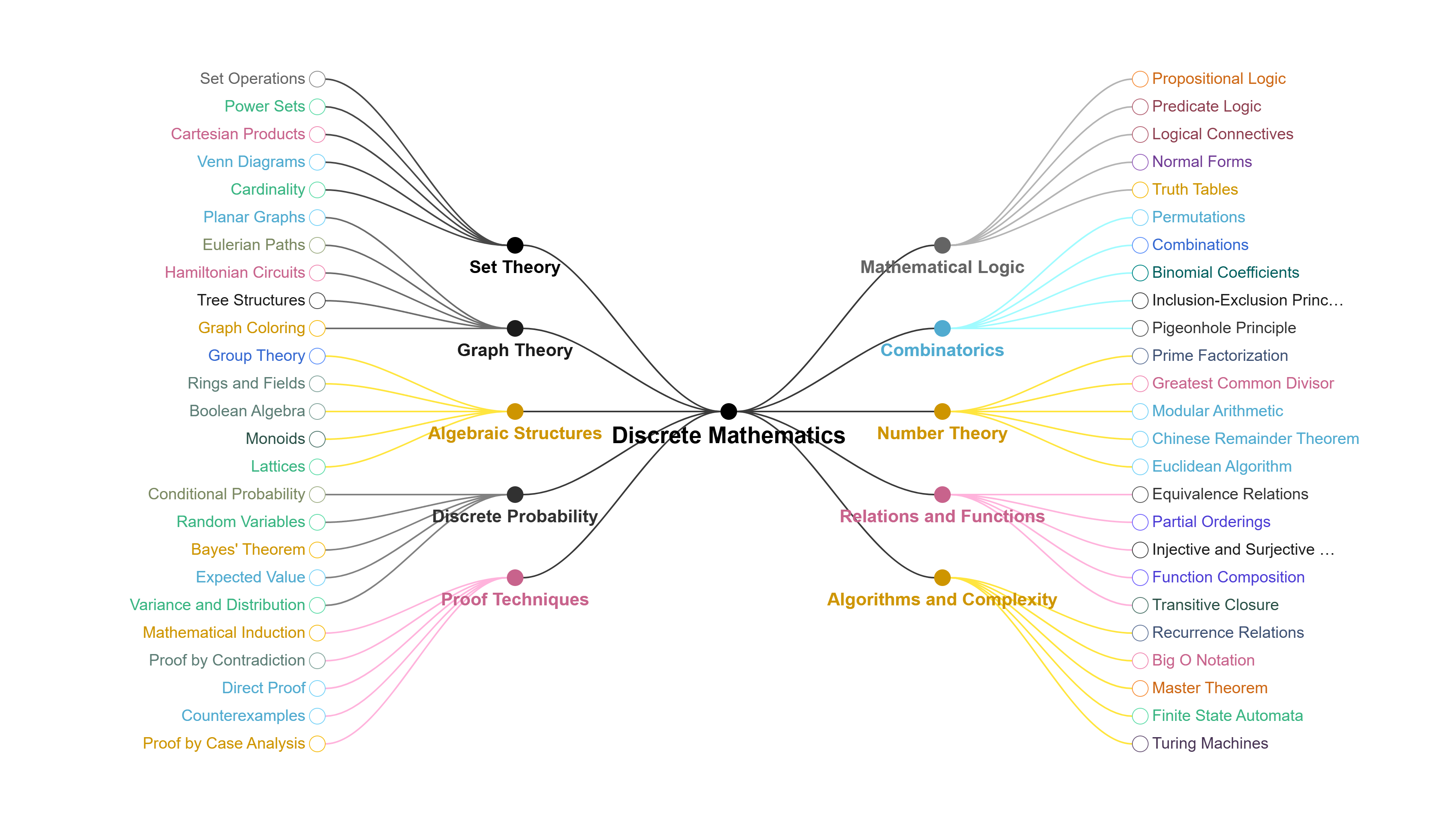
Why is discrete mathematics so difficult?
Since studying discrete mathematics requires a shift in mindset, attempting to approach it in the same way you would calculus will make it seem extremely difficult. Discrete mathematics does not emphasize computational skills; instead, it focuses on structural analysis and logical reasoning. It rarely requires you to calculate a specific value; rather, it primarily asks you to prove a proposition or construct a counterexample.
If calculus is a “computational mathematics,” then discrete mathematics is a “linguistic mathematics.” Discrete mathematics requires learners to use language to express logic. Furthermore, some problems in discrete mathematics have no standard answers (such as how to construct a graph where every vertex has a different degree), while others do have standard answers (such as the shortest path problem).
Since our primary and secondary schools do not offer logic courses and lack basic logical literacy, and even in college, only a few majors have the opportunity to encounter limited logical knowledge, students suddenly encountering rigorous logic courses will find them extremely challenging (too difficult). This is especially true when they first encounter vague terms like “obviously true,” “easy to verify,” or “easy to see”—they may feel a bit lost, wondering how something can be “obviously true” without any calculation process.
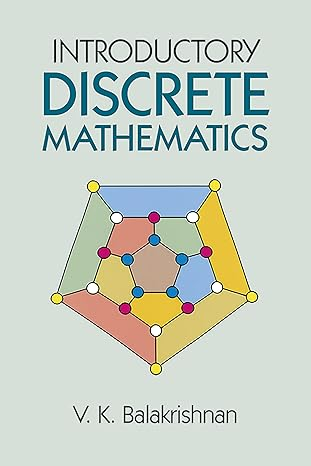
I recommend an introductory book on discrete mathematics titled Introductory Discrete Mathematics by V. K. Balakrishnan, a mathematics professor at the University of Maine. It is ideal for readers new to the subject. If you still find it challenging, you might consider the more foundational Discrete Mathematics: An Open Introduction by Oscar Levin, which focuses on developing mathematical proof skills and basic logical thinking abilities.