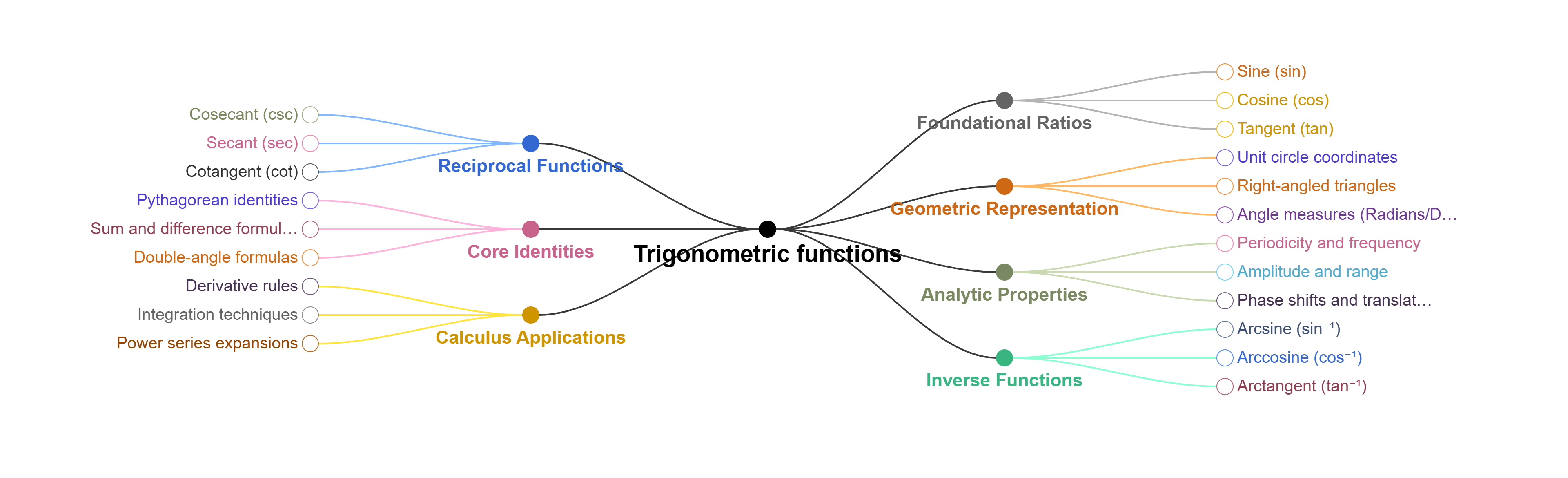
How to memorize all the trigonometric function formulas?
Gaining a detailed understanding of the history of trigonometric functions will make it easier to remember these formulas.
In ancient Greece, around the 3rd century BCE, the astronomer Hipparchus began systematically studying trigonometric relationships and compiled the world’s first table of sine values (though not in the form of sin/cos, it was generally referred to as a “chord table”). At that time, its primary uses were calculating the positions of celestial bodies, predicting solar eclipses, and determining planetary orbits.
Around the 5th–6th centuries AD, Indian mathematicians introduced the concept of sine and created more precise sine tables (while also improving computational accuracy and efficiency), though their primary purpose remained the measurement of planetary positions in astronomy.
During the Islamic period (8th–13th centuries AD), Islamic scholars built upon the Indian sine tables by adding cosine tables, while also introducing the tangent function (tanθ) and the cotangent function (cotθ). They began to apply these functions to the field of navigation, and the basic forms of modern trigonometric functions were largely established during this period.
By the Renaissance (15th–17th centuries), European scholars systematized and standardized trigonometric functions, establishing them as a branch of mathematics. They were primarily used in cartography, astronomical surveying, and navigation.
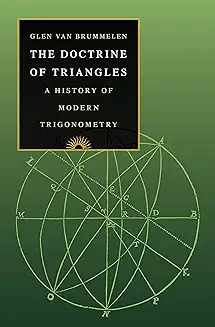
Published by Princeton University Press, The Doctrine of Triangles: A History of Modern Trigonometry by Glen Van Brummelen is a book dedicated to the history of trigonometric functions, and it also introduces their specific applications in modern science.
In the 19th century, mathematician Euler introduced trigonometric functions into the realm of mathematical abstraction, freeing them from the confines of geometry and expanding their scope to include calculus, engineering, and physics. Influenced by Euler, more scientists further expanded the use of trigonometric functions, leading to their application in fields such as the Fourier transform, complex analysis, and signal processing.